
Fast, reliable pest control from Hernando County’s most trusted family-owned team—with most quotes given over the phone.
Contact Info
Fast, reliable pest control from Hernando County’s most trusted family-owned team—with most quotes given over the phone.
Contact Info
You've sprayed, you've baited, you've wiped down every surface. The ants are still there. Here's the real reason why — and what actually works.

You noticed a trail of ants across your kitchen counter. You grabbed a can of spray, hit them hard, and figured that was that. A few days later, they were back — sometimes in a completely different spot, sometimes in even greater numbers. If that sounds familiar, you’re not doing anything wrong. The products just aren’t built to solve the actual problem. Florida ants, and especially the species common across Hernando County and Pasco County, behave in ways that make most store-bought treatments not just ineffective, but occasionally counterproductive. Here’s what’s actually happening — and what a different approach looks like.
The short answer is that most consumer sprays are repellents. They’re designed to create a chemical barrier that ants detect and avoid. That sounds useful, but here’s the problem: ants don’t just disappear when they can’t cross a barrier. They reroute. They split. They find another way in, or they establish new entry points entirely.
With certain Florida ant species — ghost ants in particular — this splitting behavior is a documented survival response called budding. When a colony senses a chemical threat, it doesn’t retreat. It divides into multiple sub-colonies and spreads. One colony becomes three. Three can become nine. The spray you used to solve your ant problem may have quietly multiplied it.
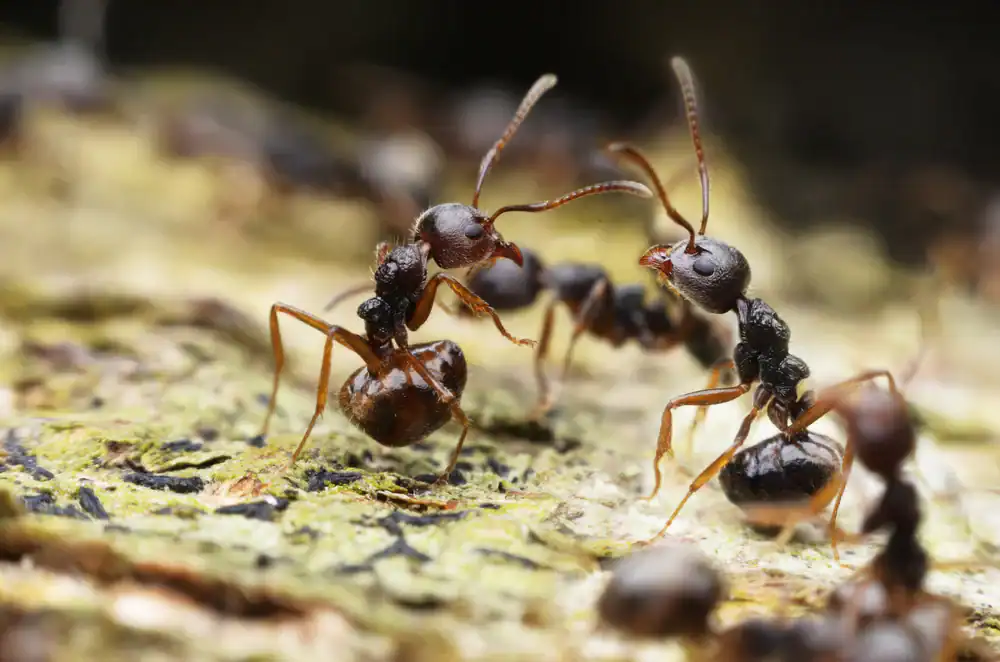
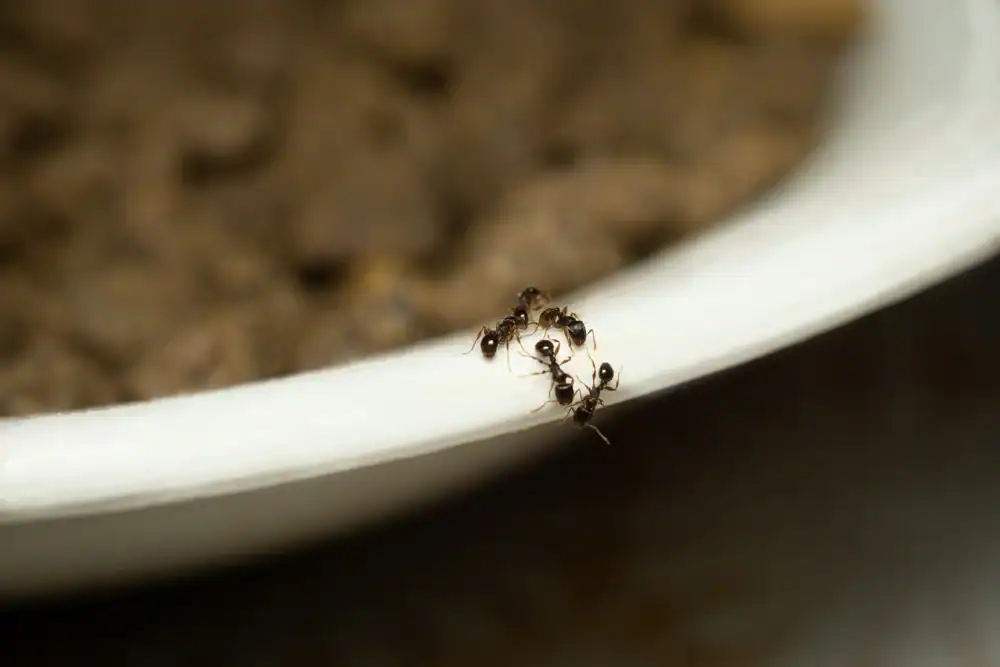
Budding happens in ant species that maintain multiple queens within a single colony. Ghost ants — the tiny, pale-bodied ants with dark heads that are arguably the most common indoor pest in Florida — are a prime example. Because the colony doesn’t rely on a single queen for survival, it can fragment when threatened and rebuild from multiple starting points simultaneously.
When you spray a repellent product along a trail or at an entry point, worker ants carry that chemical signal back through the colony. In a species prone to budding, that signal triggers a dispersal response. Workers and queens scatter into wall voids, behind baseboards, under slab gaps, and into spaces you’ll never see until the new sub-colonies are well established.
This is why so many homeowners describe the same experience: spray once, get a few days of relief, then notice ants appearing somewhere new — the bathroom instead of the kitchen, the bedroom instead of the hallway. It’s not a coincidence. It’s the colony adapting.
Professional-grade treatments work on a completely different principle. Non-repellent insecticides — the class of products we use in professional ant control — are undetectable to ants. Workers cross through treated zones, pick up the active ingredient on their bodies, and carry it back into the colony through normal grooming and food-sharing behavior. The product reaches the queens and satellite nests that a spray can never touch. That transfer effect is what actually eliminates a colony rather than just moving it around.
The distinction matters enormously in Hernando County and Pasco County, where ghost ants and carpenter ants are active year-round and where the humidity that comes with living near the Gulf creates ideal conditions for colonies to expand quickly once they’re established indoors.
It matters more than most people realize. Florida has more than 200 known ant species, and while only a handful regularly invade homes, those that do each require a meaningfully different treatment approach. Using the wrong method doesn’t just fail — it can waste weeks of time while the colony continues to grow.
Ghost ants are moisture-seekers. They trail to kitchen sinks, bathroom fixtures, and anywhere condensation collects. Their colonies are diffuse, with multiple queens and satellite nests spread across wall voids and exterior entry points. Baiting protocols for ghost ants need to account for that spread — a single perimeter spray won’t reach every nest site.
Carpenter ants are a different situation entirely. They don’t eat wood, but they excavate it to build galleries for nesting. In the older housing stock common across Spring Hill, Brooksville, and Hernando Beach — homes with mature oak canopies overhead and aging construction that creates easy entry points — carpenter ants can establish satellite nests inside wall voids, attic insulation, and hollow door frames. Those satellite nests can be located 20 to 100 feet from the main colony, which is why surface treatment rarely resolves a carpenter ant problem on its own.
Fire ants present yet another challenge. Their colonies can extend several feet into Florida’s sandy soil, and the queen lives in the lower chambers where DIY mound drenches almost never reach. If the queen survives, the colony recovers within days.
This is why identifying the species before treating isn’t a formality — it’s the foundation of any approach that’s actually going to work. Treating ghost ants like fire ants, or carpenter ants like sugar ants, produces results that feel random because they are. The treatment was never matched to the pest.
For homeowners who’ve recently relocated to Pasco County or Hernando County from northern states, this is often the missing piece. Ghost ants and big-headed ants simply don’t exist in most northern climates. The mental models and product knowledge that worked back home don’t translate here, and that’s not a failure of effort — it’s just a different pest environment that requires local knowledge.
Want live answers?
Connect with a Around The Clock Pest Service expert for fast, friendly support.
Professional ant control starts with identification — not assumptions. Before any product is applied, the species, the likely nest sites, and the entry points all need to be understood. That assessment shapes everything that follows: which products we use, where we apply them, and whether baiting, perimeter treatment, or a combination approach makes the most sense.
From there, our focus is on reaching the colony — not just the workers visible on the surface. Non-repellent treatments applied to exterior perimeters, entry points, and targeted interior locations allow the active ingredient to transfer through the colony over time. Research from the University of Florida’s Entomology and Nematology Department indicates that this class of treatment can reduce ant activity by more than 90 percent within two to four weeks.
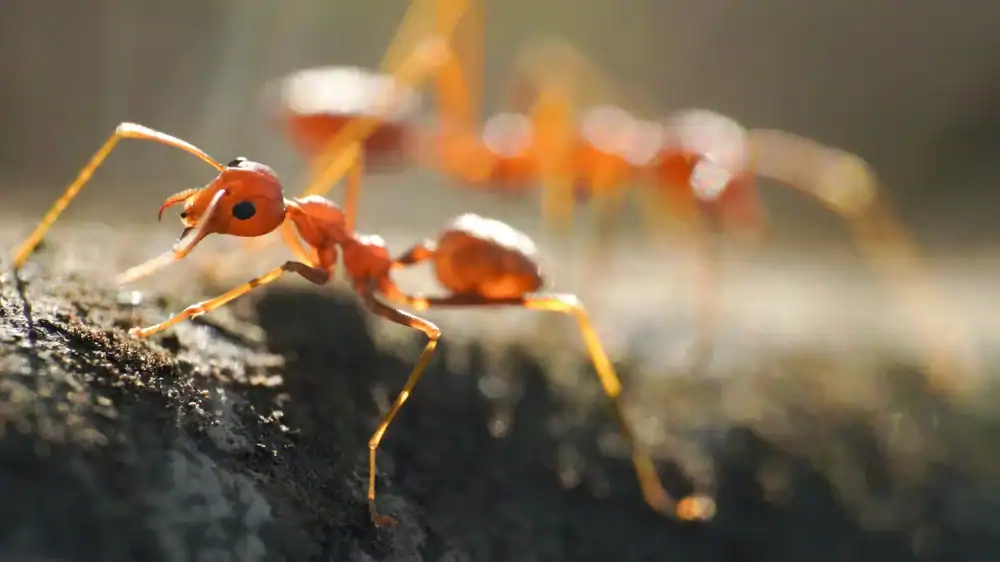
The Nature Coast’s summer rainy season — roughly June through September — is one of the most consistent drivers of ant service calls across both counties. When the ground saturates during heavy thunderstorm patterns, ground-level ant nests flood. Colonies don’t drown. They relocate upward, moving into wall voids, behind baseboards, and under slab foundations to find dry shelter.
For homeowners in Hernando County communities like Spring Hill, Brooksville, and Hernando Beach, this is often the moment an ant problem that seemed manageable outdoors becomes an indoor infestation almost overnight. The ants weren’t invited in — they were pushed in by rising groundwater.
This seasonal dynamic is one reason why a one-time treatment, while valuable for eliminating an active infestation, doesn’t fully address the recurring pressure that comes with living in this climate. We recommend quarterly prevention programs designed around this reality. Regular perimeter applications maintain a treated zone around your home’s foundation and entry points, so that when the next rainy season pushes colonies toward dry shelter, there’s already a barrier in place — not one you’re scrambling to establish after the ants have already moved in.
Properties that back up to wooded conservation land, which describes a significant portion of homes in the Weeki Wachee area and along the edges of the Withlacoochee State Forest, face additional exterior pressure that makes ongoing prevention especially worthwhile. The forest isn’t going anywhere, and neither is the ant population living in it.
The most important thing is probably the simplest: someone who answers the phone. That sounds like a low bar, but it’s genuinely not in this market. A number of homeowners across Spring Hill, Brooksville, and the surrounding areas have had the experience of calling a pest company, leaving a message, and waiting — sometimes for days — while the ant problem continues. That’s the baseline frustration that drives people to keep trying DIY products long after they’ve stopped working.
Beyond responsiveness, licensing matters. In Florida, pest control operators are licensed and regulated by the Florida Department of Agriculture and Consumer Services under Chapter 482 of the Florida Statutes. A legitimate company should be able to provide license numbers on request — and those numbers should be verifiable. Holding multiple licenses across different pest control categories signals that the operator has met the training, experience, and examination requirements for each one, not just the minimum needed to operate.
It’s also worth asking whether the company will give you a quote over the phone before committing to an in-person visit. We can assess a residential ant problem over a straightforward call and provide honest pricing without requiring a formal inspection first. That transparency — no hidden fees, no pressure — is a reasonable expectation, not a premium.
For new homeowners in Hernando County and Pasco County, especially those who’ve moved to the Nature Coast recently and are navigating Florida pest species for the first time, having a direct line to someone who can answer questions honestly and without a sales pitch is genuinely valuable. The same goes for military families who PCS into the area quickly and need to establish a reliable local service relationship without a lot of time to research options. We offer specific discounts for both groups — worth asking about when you call.
Finally, look for a company that talks about follow-up. A professional treatment applied correctly should show significant results within two to four weeks, but a single visit rarely tells the whole story. A 30-day follow-up to assess colony elimination and apply supplemental treatment if needed is standard practice among quality operators — and it’s the difference between a problem that’s resolved and one that quietly comes back.
If you’ve been through two or three rounds of store-bought sprays and the ants are still finding their way in, it’s not a persistence problem — it’s a method problem. Repellent products aren’t built to reach colonies, and Florida’s ant species are too varied and too well-adapted to respond reliably to generic treatments.
What works is species-correct identification, a treatment approach that reaches the colony rather than just the workers you can see, and a follow-up plan that accounts for the seasonal pressure that comes with living on the Nature Coast.
If you’re dealing with an active infestation in Hernando County or Pasco County or just want to get ahead of the next rainy season before it pushes colonies indoors, Around The Clock Pest Service is worth a call. Most quotes are handled over the phone, someone answers every time, and the same person who gives you that quote is the one who shows up at your door.
Summary:
Article details:
Share: