
Fast, reliable pest control from Hernando County’s most trusted family-owned team—with most quotes given over the phone.
Contact Info
Fast, reliable pest control from Hernando County’s most trusted family-owned team—with most quotes given over the phone.
Contact Info
Tiny ants taking over your kitchen or bathroom? Here's why the spray you bought isn't working—and what's really going on inside your walls.
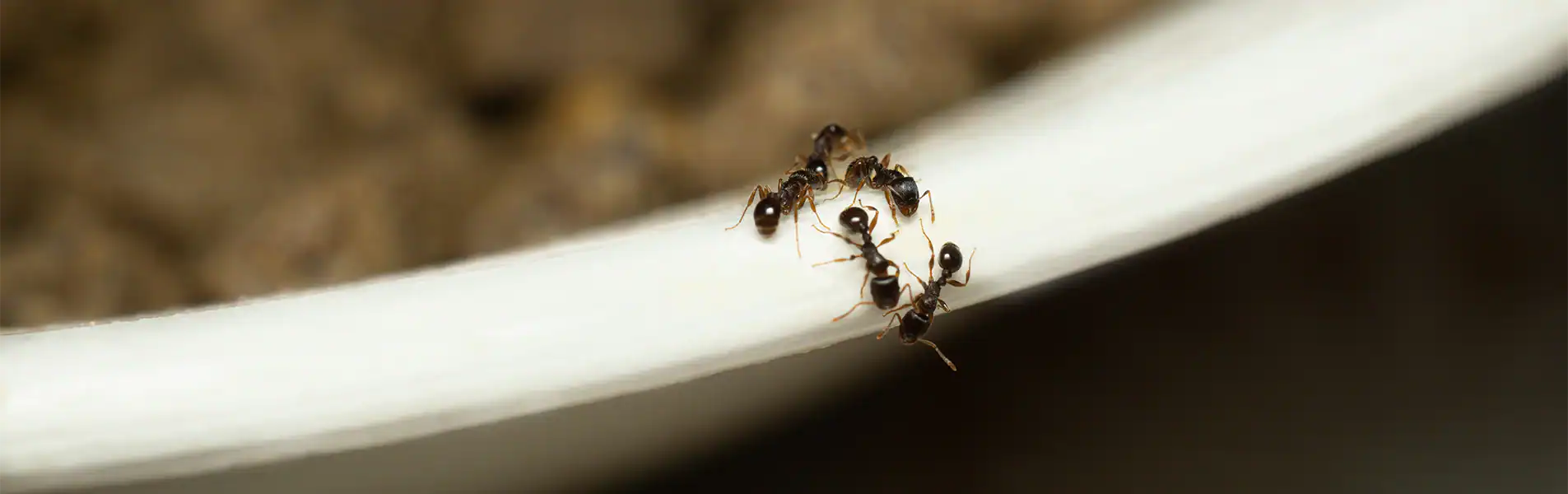
You noticed a few tiny ants near the bathroom sink. You grabbed a spray, hit the trail, and figured that was the end of it. A week later, they’re in the kitchen too. Now they’re behind the microwave, along the baseboard, and somehow in a room you never saw them in before.
This is not bad luck. It’s biology—and it’s one of the most common stories we hear from homeowners across Spring Hill, Wesley Chapel, and New Port Richey. Ghost ants and pharaoh ants behave differently from most ant species, and the usual fix doesn’t just fail on them. It can actively make things worse. Here’s what’s actually happening, and what you can do about it.
Most people call them “sugar ants” and move on. But ghost ants and pharaoh ants are two distinct species, and that distinction matters more than most people realize—because the right treatment for one can make the other dramatically worse.
Ghost ants are roughly 1 mm long, about the size of a pinhead. Their abdomens are nearly translucent, which makes them almost invisible against light-colored countertops and tile. Their heads and thoraxes are dark, giving them a two-toned look when you can actually spot them. One reliable identification trick: crush one and you’ll notice a faint coconut-like odor. That’s a ghost ant.
Pharaoh ants are slightly larger—around 1.5 to 2 mm—and are yellow to light-brown throughout, with a slightly darker midsection. They don’t have the translucent body that ghost ants do. Both species travel in trails and both favor warm, humid environments, which is exactly what Pasco County, FL and Hernando County homes provide year-round.

Ghost ants aren’t difficult to eliminate because they’re particularly aggressive or resilient in the traditional sense. They’re difficult because of how their colonies are structured—and because that structure turns most standard control methods against you.
A ghost ant colony doesn’t have one queen. It has multiple queens, spread across multiple nesting sites that may be in completely different parts of your home. One group might be nesting in a wall void near your bathroom plumbing. Another might be in the soil outside, running a trail in through a crack in the slab near your back door. A third could be tucked behind a kitchen cabinet, drawn in by moisture from the dishwasher line. You’re not dealing with one problem—you’re dealing with a network.
This is why the visible ants you see foraging across your countertop are only a fraction of what’s actually present. Killing the foragers doesn’t touch the queens, the larvae, or the reproductive core of any of those colonies. The colony simply sends more workers.
Florida’s climate makes this worse. In states with real winters, ant activity slows down or stops entirely during the cold months, which gives homeowners a natural reset window. That doesn’t happen here. In Pasco County, FL and Hernando County, ghost ants are a year-round pressure. During the rainy season—roughly June through September—outdoor nests flood and ants push indoors in large numbers. But even outside of that window, the warm, humid conditions that define the Nature Coast keep colony activity running continuously.
New construction in communities like Wesley Chapel and Zephyrhills adds another layer. When soil gets disturbed during development, existing ant colonies get displaced. They don’t disappear—they migrate. New homeowners moving into freshly built homes often discover ghost ants within weeks of moving in, not because the home was poorly built, but because the surrounding landscape was recently disrupted and the ants are looking for a new home too.
This is the part that surprises most people, and it’s the most important thing to understand before you reach for anything at the hardware store.
Both ghost ants and pharaoh ants respond to repellent contact sprays by doing something called budding. When the colony senses a chemical threat, it doesn’t fight back—it splits. The queen, or multiple queens, scatter into separate satellite colonies, each capable of establishing independently. One infestation becomes two. Two become four. The ants don’t leave your home; they just relocate deeper into it and spread into areas they hadn’t reached before.
This is documented behavior, confirmed by the University of Florida’s Institute of Food and Agricultural Sciences (UF/IFAS) and observed consistently by pest professionals across the state. It’s not a fluke. It’s a survival mechanism baked into the biology of these species, and it makes them uniquely resistant to the products most homeowners try first.
The same principle applies to boric acid used incorrectly, repellent traps placed in the wrong locations, and even some over-the-counter ant baits that aren’t formulated for the right food preference. Ghost ants primarily forage for sweets. Pharaoh ants cycle between protein and sweet food sources depending on the colony’s needs at a given time. Using a protein-based bait on a ghost ant colony, or placing bait too close to a nest, can trigger the same scattering response.
What actually works is a slow-acting, non-repellent bait that worker ants carry back to the colony. They share it with the queens and larvae before it takes effect. The colony doesn’t detect the threat and doesn’t scatter—it absorbs the treatment and collapses from within. This is the professional standard for both species, and it’s why the approach matters as much as the product. In slab-on-grade homes throughout Spring Hill and New Port Richey—where ant entry points through foundation cracks and utility penetrations are common—treatment also needs to address those pathways directly, not just the visible trails.
Want live answers?
Connect with a Around The Clock Pest Service expert for fast, friendly support.
Professional ant control for ghost ants and pharaoh ants starts with species identification. That’s not a formality—it’s the foundation of the entire treatment plan. The wrong approach for the wrong species doesn’t just waste money. It can set you back weeks and expand the infestation.
From there, a proper treatment combines colony-targeted baiting with perimeter work and, where needed, exclusion—sealing the entry points that give ants access to the structure in the first place. For Florida homeowners dealing with year-round outdoor colony pressure, a quarterly prevention program is the professional recommendation, not because pest control companies want recurring revenue, but because one treatment can’t hold back continuous outdoor pressure indefinitely.
We’ve found that homeowners in Pasco County, FL and Hernando County who commit to quarterly service see the best long-term results. It’s not just about eliminating the current infestation—it’s about staying ahead of the outdoor pressure that never really stops in this region.

**Are ghost ants dangerous?**
Ghost ants are not known to bite humans or transmit disease in the way some other species do. The concern with ghost ants is primarily contamination—they forage across food prep surfaces, get into pantry items, and travel through areas where sanitation matters. Pharaoh ants are a more serious concern in that regard, particularly in homes with immunocompromised individuals. They’ve been associated with pathogen transmission in hospital settings, and while the risk in a residential home is lower, it’s not zero.
**Why do I keep getting ants in my bathroom?**
Bathrooms are a primary target for ghost ants specifically because of moisture. They’re drawn to water sources, and the plumbing in a typical Pasco County, FL or Hernando County home gives them exactly what they need—consistent humidity, pipe penetrations through the slab that serve as entry highways, and warm wall voids near water lines where they can nest undisturbed. If you’re seeing tiny translucent ants near your sink, shower, or toilet, ghost ants are the most likely culprit in this region.
**Do I really need quarterly pest control for ants in Florida?**
For most of the country, seasonal pest control makes sense. Florida is different. There’s no winter dormancy cycle for ghost ants or pharaoh ants in Pasco County, FL and Hernando County—the climate simply doesn’t get cold enough to interrupt colony activity. Outdoor colony pressure is continuous, which means a single treatment will hold for a while, but it won’t hold indefinitely. Quarterly perimeter treatments are the professional standard for this reason, not an upsell.
**Can I get rid of ghost ants myself?**
You can reduce visible activity temporarily, but eliminating the colony—or colonies—is genuinely difficult without the right products and application approach. The risk of making things worse with a repellent spray is real and well-documented. If you’ve already tried and watched the problem spread, that’s a strong signal that the infestation needs a different approach than what’s available over the counter.
**How do I know if I have ghost ants or pharaoh ants?**
Size and color are your best starting points. If the ants are nearly invisible—roughly the size of a pinhead—with a dark head and a pale, almost see-through abdomen, you’re most likely looking at ghost ants. Crush one and check for that faint coconut smell. If the ants are slightly larger and uniformly yellow or light brown throughout, pharaoh ants are more likely. Both species travel in trails and both favor warm, moist environments, so location alone won’t tell you much. If you’re genuinely unsure, a quick phone call to a licensed professional who knows these species is faster and more reliable than trying to diagnose it yourself with a magnifying glass.
**Why did the ant problem get worse after I moved into my new home?**
This is extremely common in Pasco County, FL’s rapidly growing communities—Wesley Chapel, Land O’ Lakes, Zephyrhills, and surrounding areas where new construction has been constant over the past several years. When land gets cleared and graded for development, existing ant colonies get displaced. They don’t die—they move. New homes built on recently disturbed soil are often adjacent to those displaced colonies, and ghost ants in particular are quick to explore new structures in search of food, moisture, and nesting space. If you moved in recently and discovered ants within the first few weeks or months, this is likely what happened. It’s not a reflection of the home’s quality. It’s a consequence of the landscape around it.
**What should I expect from a professional ant treatment?**
A proper treatment starts with a conversation—ideally one where you can describe what you’re seeing, where you’re seeing it, and what you’ve already tried. That context matters, because it informs the species identification and the treatment approach. From there, expect a combination of targeted baiting, perimeter treatment, and entry point assessment. You won’t see instant results with the slow-acting baits used for ghost and pharaoh ants—that’s actually a good sign, because it means the bait is being carried back to the colony rather than triggering a scatter response. Most homeowners see a significant reduction in activity within one to two weeks.
**Is the treatment safe for my kids and pets?**
Yes. State-certified pest control in Florida requires licensed applicators to use products and application methods that meet FDACS safety standards. You’ll typically be advised to keep people and pets out of treated areas for a short period after application—your technician will walk you through the specifics before they start.
Ghost ants and pharaoh ants are genuinely stubborn pests—not because they’re impossible to control, but because they respond so poorly to the methods most homeowners try first. Understanding that is half the battle. The other half is getting a treatment approach that targets the colony, not just the trail of ants you can see.
If you’re in Spring Hill, Wesley Chapel, New Port Richey, Brooksville, or anywhere else in Pasco County, FL or Hernando County and you’ve been fighting this problem without making real progress, it’s worth talking to someone who can actually identify what you’re dealing with and explain what the treatment plan looks like before you commit to anything.
Around The Clock Pest Service answers every call directly—no phone tree, no call center. Most quotes are given over the phone, same day. If you’re ready to stop guessing and start getting answers, give us a call.
Summary:
Article details:
Share: