
Fast, reliable pest control from Hernando County’s most trusted family-owned team—with most quotes given over the phone.
Contact Info
Fast, reliable pest control from Hernando County’s most trusted family-owned team—with most quotes given over the phone.
Contact Info
If sugar ants keep showing up in your kitchen no matter what you try, there's a reason — and it's not what most people think.

You keep a clean kitchen. You’ve wiped the counters, taken out the trash, and tried the spray from the hardware store. And yet, every morning, there they are — those tiny, barely-visible ants moving in a line across your counter like you didn’t just deal with this yesterday.
Here’s the thing: it’s not your cleaning routine that’s failing you. It’s the approach. Florida sugar ants — specifically ghost ants, which are the species most Pasco and Hernando County homeowners are dealing with — behave in ways that make standard DIY methods not just ineffective, but sometimes actively counterproductive. We’ve helped hundreds of homeowners in this area solve the problem the right way, and this post explains why the old methods fail, and gives you five genuinely useful tips to get ahead of them.
When most Florida homeowners say “sugar ants,” they’re usually looking at ghost ants — a species that’s nearly translucent, about 1/16 of an inch long, and almost impossible to spot on a white kitchen counter until there are a lot of them. They have dark heads and pale, see-through abdomens, and they move fast. You’ll also sometimes see acrobat ants or rover ants lumped into the same “sugar ant” category, and each one behaves a little differently.
What makes ghost ants particularly stubborn is their colony structure. Most ant species operate with a single queen. Ghost ant colonies can have multiple queens spread across multiple nesting sites — sometimes inside your walls, sometimes in a potted plant, sometimes in the mulch right outside your back door. That’s why killing the ants you can see rarely solves anything. The colony itself is untouched.

This is the part that surprises most people, and it’s worth understanding before you reach for another can of spray.
Ghost ants have a survival response called budding. When their colony is stressed — by a repellent chemical, a disruption to their trail, or a sudden loss of workers — they don’t retreat. They split. A stressed ghost ant colony will fracture into multiple smaller colonies, each one relocating with its own queen and starting fresh somewhere new. That somewhere new is often deeper inside your home.
So when you spray a trail of ants moving across your kitchen counter, you may kill the twenty or thirty ants you can see. But if the colony detects that chemical threat, you could end up with three or four new colonies establishing themselves behind your dishwasher, under your refrigerator, or inside a wall void — within days. This isn’t a worst-case scenario. It’s a documented, predictable response that we deal with constantly in Pasco and Hernando County.
This is also why the over-the-counter products that work reasonably well on other ant species can make ghost ant infestations significantly worse. Products that repel rather than eliminate are particularly problematic. The ant trail disappears for a day or two, you think it worked, and then the problem comes back in a different spot — usually a worse one.
The takeaway isn’t that you should do nothing. It’s that what you do matters. Slow-acting baits that worker ants carry back to the colony and share with the queen are far more effective than contact sprays for this specific reason. The goal is colony elimination, not trail elimination. Those are two very different outcomes.
One of the most frustrating things homeowners tell us is that their kitchen is spotless and the ants still won’t leave. That frustration makes complete sense, because the assumption — that ants are there because of visible food — is only part of the story.
Ghost ants are drawn to microscopic food residue that no amount of wiping fully eliminates. The film left behind on a coffee maker, the faint sugar trace around a jar lid, the invisible residue near a drain — these are more than enough. But food isn’t even the whole picture. Moisture is just as powerful an attractant, sometimes more so.
In Hernando and Pasco County homes, this plays out in very specific ways. The Gulf-driven humidity that defines the Nature Coast means that even well-maintained kitchens have moisture under appliances, around sink plumbing, and near the dishwasher seal. A slow drip under the cabinet that you haven’t gotten around to fixing is essentially an invitation. So is the condensation that builds up on the back of a refrigerator during a humid Florida summer.
There’s also the outdoor connection that most people underestimate. If you have aphids on plants near your home, those aphids produce a sticky substance called honeydew that ghost ants actively seek out. Oak trees — which are everywhere in Spring Hill and Brooksville — drop leaf litter that retains moisture and provides perfect harborage right against your foundation. Tree branches or shrubs touching your roofline give ants a direct bridge inside. The kitchen infestation you’re dealing with often starts well outside your home, and no amount of interior cleaning addresses that entry point.
Want live answers?
Connect with a Around The Clock Pest Service expert for fast, friendly support.
These aren’t generic tips you’ve already read. They’re grounded in how Florida ghost ants actually behave and what the specific conditions in this part of the state create for homeowners. Some of these you can handle yourself. Others are a strong signal that it’s time to bring in someone who knows the local pest environment well.
Work through them in order — the first few address the most common entry points and attractants, and the last two get into what separates a temporary fix from a real solution.
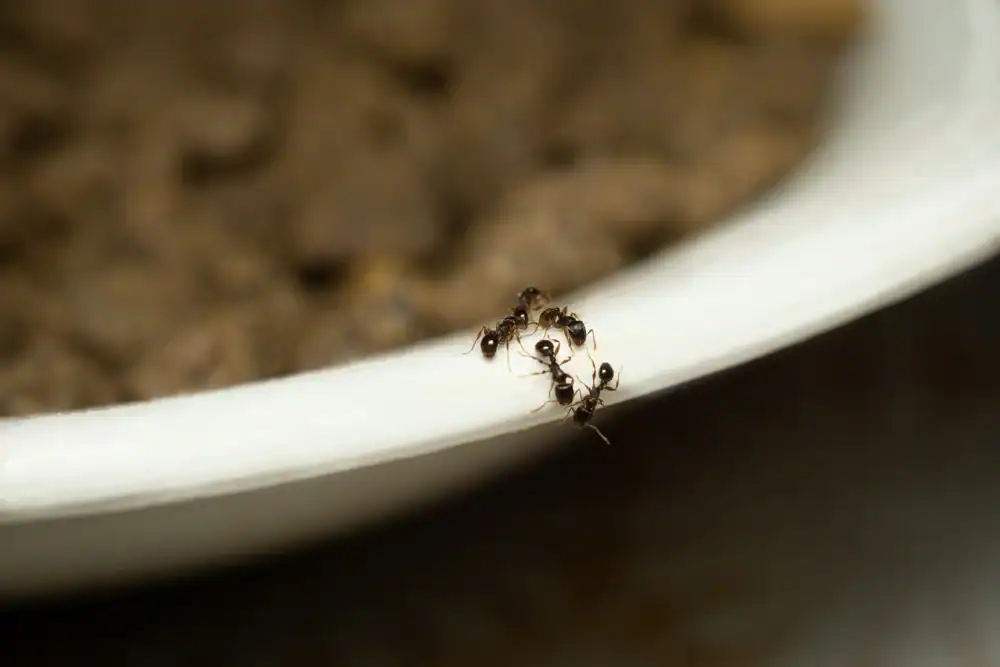
The first tip is to fix moisture before you fix anything else. Check under your kitchen sink, around the base of your dishwasher, and behind the refrigerator. A slow drip or persistent condensation is a more powerful ant attractant than a crumb on the counter. In Pasco and Hernando County, where humidity is a constant and rainy season runs from June through September, moisture management is genuinely the highest-leverage thing a homeowner can do on their own.
The second tip is to pull landscaping and mulch back from your foundation. This is something a lot of Florida homeowners overlook because the landscaping looks fine — but mulch pressed against your home’s base stays damp, stays warm, and gives ant colonies ideal nesting conditions right next to a potential entry point. A gap of at least a foot between mulch or plant beds and your exterior wall makes a real difference. If you have oak trees with branches touching or near your roofline, trimming those back removes a direct highway inside.
The third tip is to switch from spray to bait — and be patient with it. If you want to try a DIY approach before calling us, slow-acting bait stations give worker ants something to carry back to the colony rather than a chemical that triggers budding. Place them along active trails, not in the middle of the kitchen floor. Don’t spray anything near the bait stations — that will drive the ants away from the bait and defeat the purpose entirely. Give it several days before you judge whether it’s working. The goal is for the bait to reach the queens, and that takes time.
Tip four is to seal your entry points — and be specific about where to look. In Florida slab-construction homes, which make up the majority of the housing stock in Spring Hill, Brooksville, and the surrounding area, the most common ant entry points are weep holes in brick or block exteriors, expansion joints in the foundation, utility penetrations where pipes and wires enter the home, and deteriorating caulk around windows and door frames. These are small gaps that are easy to miss, but ghost ants need almost no space to get through. A tube of exterior caulk and an hour on a weekend afternoon can close off several of these. It won’t solve an active infestation on its own, but it’s an essential part of any long-term solution.
Tip five is to recognize when you’ve hit the limit of what DIY can reasonably accomplish. If you’ve tried bait, sealed what you can find, addressed the moisture, and the ants are still coming back, the colony is almost certainly established somewhere you can’t reach or treat safely on your own. Multi-queen ghost ant colonies nested inside wall voids, behind baseboards, or in outdoor harborage sites close to the home require professional-grade non-repellent treatments applied in the right locations at the right concentrations. Getting that wrong doesn’t just waste money — it can trigger the budding response and make the infestation harder to resolve.
Professional ant control in this area involves correct species identification first, because ghost ants, acrobat ants, and rover ants all respond to different treatment approaches. It means locating nesting sites rather than just treating visible trails. It means using products that worker ants will carry back to the colony, and following up to confirm the colony has been eliminated — not just suppressed. Florida’s year-round subtropical climate means ant colonies never fully die off between seasons the way they do in cooler states, which is why a one-time treatment without a prevention plan often leads to reinfestation within a few months. A quarterly prevention program addresses that ongoing pressure in a way that a single service call simply can’t.
If you’ve read this far, you probably already know that what you’ve been trying isn’t working — and now you have a clearer picture of why. Ghost ants in a Florida kitchen aren’t a reflection of how clean you keep your home. They’re a biology problem, a moisture problem, and often an entry-point problem that starts well outside your kitchen walls.
The five tips above will help, and some of them may be enough. But if the infestation is established, if the colony has already budded, or if you’ve been dealing with this for weeks without progress, the most practical next step is a conversation with us.
Around The Clock Pest Service serves Hernando and Pasco County homeowners with the kind of straightforward, personal service that’s genuinely hard to find — you call, you talk to the owner directly, and you get real answers without a sales pitch. Most quotes are given over the phone. If you’re ready to stop guessing and actually solve the problem, give us a call.
Summary:
Article details:
Share: