
Fast, reliable pest control from Hernando County’s most trusted family-owned team—with most quotes given over the phone.
Contact Info
Fast, reliable pest control from Hernando County’s most trusted family-owned team—with most quotes given over the phone.
Contact Info
Not every company that claims "pet safe" can back it up. Here's what that phrase actually means — and what to ask before anyone treats your home.

You’ve probably already tried the spray from the hardware store. It killed the ants you could see, and then three days later they were back — sometimes in a different spot, sometimes in greater numbers. So now you’re thinking about calling a professional, but you’ve got a dog or a cat, and every pest control company you’ve looked at says the same thing: “We use pet-safe products.” It sounds good. But what does it actually mean? Is there a standard they’re being held to, or is it just something companies say? The honest answer is that it depends entirely on who you ask — and most people never ask the right questions.
“Pet safe” is not a regulated term. There is no EPA certification, no FDACS designation, and no government-issued standard that a pest control company must meet before putting those words on their website. Any company can use it. That’s not meant to alarm you — it’s just the reality, and you deserve to know it going in.
What actually matters is the specific products being used, how they’re applied, and whether the technician can explain both of those things clearly before they set foot in your home. A licensed professional operating under Florida’s Chapter 482 Structural Pest Control Act is required to use EPA-registered products and follow label instructions — that’s the legal baseline. But beyond that baseline, there’s a significant difference between a company that applies a repellent spray along your baseboards and one that places a slow-acting bait in crack-and-crevice locations your pets can’t reach.

Here’s something most homeowners in Hernando County don’t know until it’s too late: using a repellent spray on the wrong species of ant doesn’t just fail to solve the problem — it can actively make it worse.
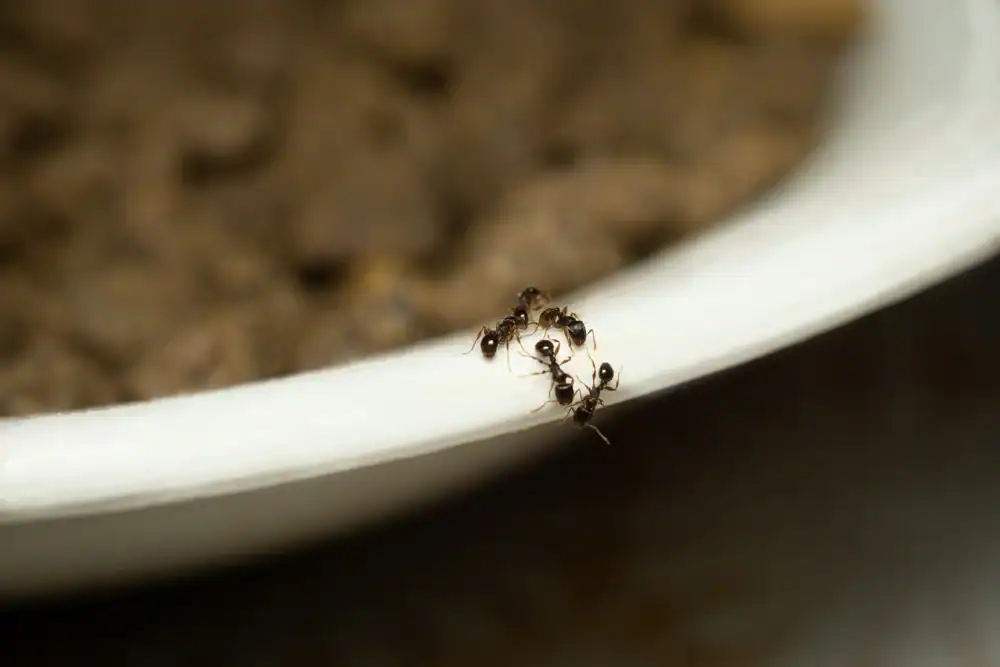
Ghost ants are the most common indoor ant in Hernando County. They’re tiny, nearly translucent, and they show up on kitchen counters and bathroom surfaces in long trailing lines. They’re also one of several Florida ant species that reproduce by a process called budding. When a ghost ant colony is disturbed by a repellent spray, it doesn’t die — it splits. A single colony can fracture into multiple new colonies, each establishing itself in a different part of your home. Pharaoh ants do the same thing. Argentine ants do too. What started as one trail across your counter can become several, spreading into walls, under appliances, and into rooms you hadn’t seen them in before.
This is one of the most important reasons why species identification matters before any treatment begins. A technician who sprays first and asks questions later is not practicing pet-safe pest control — they’re just applying a product. The method that works on ghost ants is a slow-acting, non-repellent bait placed in locations the colony will find but your pets won’t. Worker ants carry the bait back to the nest, where it spreads to the queen and the brood. The colony dies from the inside out, over the course of days to weeks, without triggering budding and without broadcasting chemicals across surfaces your dog or cat walks on.
The difference between bait and spray also matters at the concentration level. Professional bait formulations typically contain 5% or less of active ingredients. They’re placed in enclosed stations tucked into voids, under sinks, behind appliances — spots that are inaccessible to pets under normal circumstances. There’s no airborne residue, no wet surface for a curious cat to walk across, and no need to evacuate your home for hours. When we use spray, it’s targeted — applied in specific locations with a clear re-entry interval communicated to you before we leave. That’s what separates a professional approach from a can of Raid.
If a company can’t answer these questions clearly, that tells you something important before you’ve spent a dime.
First, ask them to name the products they plan to use and explain why. A qualified technician should be able to tell you the product type, whether it’s a bait or a spray, and what the EPA registration status is. If they respond with something vague like “we use safe, eco-friendly products,” push further. “Safe” without specifics is a marketing phrase, not an answer.
Second, ask about re-entry intervals. How long should your pets stay out of treated areas? The answer will vary depending on what’s being applied and where, but a professional should know it off the top of their head. For bait-based treatments placed in inaccessible locations, the interval may be minimal. For any surface application, there’s a specific dry time after which the product is no longer a contact risk. If the technician can’t give you a number, that’s a gap in their knowledge you don’t want to discover after the fact.
Third, ask them to identify the species before committing to a treatment plan. In Hernando County, you’re most likely dealing with ghost ants indoors or fire ants in the yard — and those two problems require completely different approaches. Fire ants in your lawn pose a real sting risk to dogs and cats that spend time outside, and treating them requires direct mound treatment or broadcast bait, not the same protocol used for indoor trailing ants. A technician who treats every ant call the same way regardless of species is not giving you the best outcome for your family or your pets.
When you call Around The Clock Pest Service, you’re talking directly to the owner — not a scheduling center, not a receptionist reading from a script. We can walk you through exactly what products will be used, where they’ll be placed, and what you need to do to prepare your home and protect your pets. That conversation happens before the appointment, not after.
Want live answers?
Connect with a Around The Clock Pest Service expert for fast, friendly support.
Florida doesn’t have an off-season for ants. There’s no cold snap in January that drives colonies dormant and gives you a few months of relief. In Hernando County, the subtropical climate means ant pressure is continuous — and it spikes hard during the rainy season from June through September, when heavy rainfall saturates the ground and drives ants indoors looking for dry terrain and food.
Spring Hill’s housing stock adds another layer to this. Much of the community was developed as a planned residential neighborhood beginning in 1967, which means a significant portion of the homes here are aging — and aging homes have more entry points, more moisture-compromised wood, and more established conditions for ghost ants and carpenter ants to exploit. A newer build in another part of Florida doesn’t face the same baseline pressure that a 40-year-old home in Hernando County does.

Ghost ants are the dominant indoor ant in Hernando County. They’re attracted to moisture and sweet food sources, which is why they show up in kitchens and bathrooms more often than anywhere else. They’re also nearly impossible to control with consumer sprays for the budding reason described earlier. For homes with pets, the ghost ant problem is both a pest issue and a product-selection issue — the wrong treatment means more ants, more applications, and more chemical exposure for your household over time.
Fire ants are the outdoor concern, and they’re a genuine safety risk for pets. Red imported fire ants build mounds throughout Hernando County lawns, and they’re aggressive when disturbed. A dog that steps on a mound or a cat that investigates one can receive multiple stings in seconds. Fire ant stings cause localized pain and swelling in most cases, but in animals with sensitivities, the reaction can be more serious. Treating fire ant mounds requires a different approach than treating ghost ants inside — typically direct mound treatment or a broadcast bait program across the lawn — and the product selection still matters for any pets that spend time in the yard.
Understanding which ant you’re dealing with isn’t just good pest control practice. In a home with pets, it’s the foundation of a genuinely safe treatment plan. Treating ghost ants like fire ants, or vice versa, doesn’t just waste time — it can expose your pets to more chemical contact than necessary while failing to eliminate the actual colony.
One of the most common frustrations we hear from homeowners in Hernando County is that they had ant treatment done, it worked for a while, and then the ants came back. That’s not necessarily a sign of a bad treatment — it’s often a sign that the treatment addressed an active infestation without accounting for Florida’s continuous pest pressure.
Colony elimination via slow-acting bait takes days to weeks to complete. Even after the original colony is gone, new foragers from neighboring colonies will probe your home’s entry points, especially during the rainy season when conditions drive them indoors. In a climate like Hernando County’s, a single treatment is rarely a permanent solution. That’s why a quarterly prevention plan makes practical sense here — not as an upsell, but as an honest reflection of how ant pressure works in this environment.
For customers on a quarterly plan with us, we include free re-treatments between scheduled visits at no extra charge. If ants show up between appointments, you don’t pay again — we come back and handle it. That structure matters for pet owners especially, because it means you’re not facing the choice between tolerating an ant problem and calling for another round of treatment on short notice. The plan accounts for the reality of living in Florida, where pest pressure doesn’t take a break just because your last service visit was two months ago.
The other piece of ongoing control that often gets overlooked is prevention — sealing entry points, addressing moisture sources, and reducing the conditions that attract ants in the first place. These aren’t dramatic interventions. They’re the kind of practical steps a knowledgeable technician points out during a visit: a gap around a pipe under the sink, a leaking faucet creating a moisture pocket behind a cabinet, a crack in the foundation near a door frame. Fixing those things doesn’t require chemicals at all, and for homes with pets, reducing the need for chemical application is always the better outcome.
The short version of everything above: “pet safe” means something specific when it’s backed by the right products, the right methods, and a technician who can explain both before they start. It doesn’t mean much when it’s just a phrase on a website.
If you’re in Hernando County and you’re dealing with ants — whether it’s ghost ants trailing across your kitchen counter or fire ant mounds appearing in the yard where your dog runs — the most important thing you can do is ask the right questions before you hire anyone. What species is it? What product will you use? Where will it go? How long do I keep my pets out? A company that answers all of those clearly, without hesitation, is a company worth trusting.
Around The Clock Pest Service is a family-owned, owner-operated business based in Spring Hill. When you call, you reach the owner directly — someone who can answer your questions, explain the plan, and give you a quote over the phone without any runaround. If that’s the kind of conversation you’re looking for, give us a call.
Summary:
Article details:
Share: